
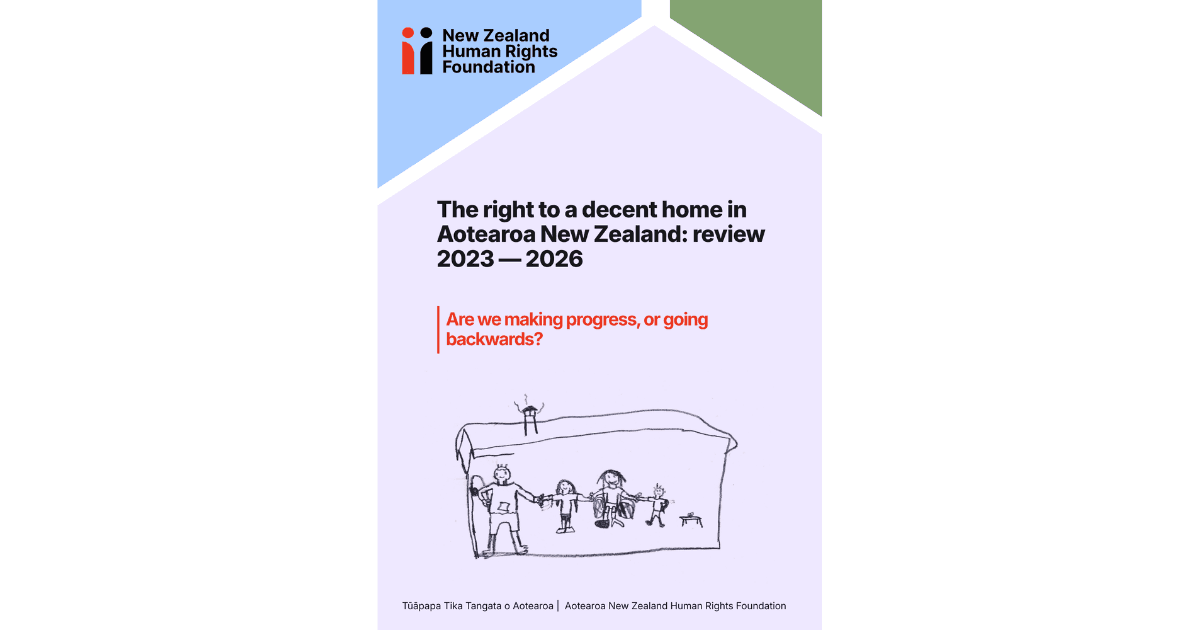
The right to a decent home in Aotearoa New Zealand: review 2023 — 2026
Are we making progress, or going backwards?
A decent home is the foundation for dignity, yet report finds Government moving backwards on housing rights
Reversing recent policy changes and embedding a human rights and Te Tiriti o Waitangi framework into housing decision-making are among the key recommendations of a major review of housing rights released today by the Aotearoa New Zealand Human Rights Foundation.
The right to a decent home in Aotearoa New Zealand: review 2023-2026 finds almost no progress in realising the right to a decent home since 2023. It identifies a broader shift towards market-led housing policy, without a corresponding commitment to embedding human rights and Te Tiriti o Waitangi obligations in housing decision-making. Several government initiatives have contributed to declines in affordability, security of tenure, accessibility and cultural adequacy, leaving Aotearoa "running backwards" on both housing rights and Te Tiriti commitments.
"If Aotearoa is to meaningfully address the persistent housing crisis, the government must put human rights and Te Tiriti obligations at the centre of housing policy," says Aaron Packard, Chairperson of the Aotearoa New Zealand Human Rights Foundation.
"Instead, recent government policy has moved in the opposite direction, entrenching inequality and reinforcing the treatment of housing as a speculative asset.
Even where there have been modest improvements in individual measures (for example dampness and mould), persistent housing inequality remains largely unchanged, particularly for Māori, Pacific peoples, disabled people and renters.
In 2019, the UN Special Rapporteur on adequate housing Leilani Farha identified housing in Aotearoa as:
“having lost its function as home – a place to live – as that concept has been replaced with the notion that housing is a speculative asset.”
Farha found this approach was driving inequality in Aotearoa.
"International law requires the government to ensure every home meets basic human rights standards, including when relying on the private sector to build homes for the public, yet current policy which favours cost and speed over all else fails to achieve these essential requirements," says Packard.
Systemic failures in the housing system mean that disabled people, Māori, and Pacific Peoples particularly struggle to have their right to a decent home realised.
Going ‘backwards without justification’ on Te Tiriti o Waitangi
Māori housing expert and Foundation committee member Jacqueline Paul says recent government housing policy has moved away from Māori-led and te ao Māori-informed approaches.
"The Government has actively discouraged a Te Tiriti o Waitangi rights and accountability framework, taking Aotearoa backwards without justification. This is clear in the end of dedicated funding for Māori-led housing programmes, in favour of contestable funds that pits Māori housing providers against other providers.
“We call on the Government to reinstate dedicated funding for Māori-led housing, and to work in partnership with tangata whenua in housing decisions," says Paul.
Government policies fail to meet essential human rights standards
The Foundation's analysis identifies specific policies that violate the government's immediate human rights obligations, as determined by Te Kāhui Tika Tangata Human Rights Commission, in its housing inquiry:
- Social housing rent increases: Budget 2026 raises rents for social housing tenants from 25% to 30% of their income, while pushing tenants into the private rental market where costs are even higher.
- Tighter emergency housing access: One in three emergency housing applications are now being declined (33.2% between October 2025 and March 2026), compared to just 4% in March 2024. Nearly 30% of those declined receive no alternative support, breaching the government's immediate obligation not to evict people into homelessness.
- Kāinga Ora evictions: 74 households lost their tenancies in 2024/25, up from zero two years earlier, with Pacific and Māori tenants disproportionately affected
- Accessibility target scrapped: Kāinga Ora abandoned its commitment to making 15% of new homes accessible for disabled people in May 2026
Impacts of the decisions hit hard, but are avoidable
The Foundation says the impact of policy that breaches human rights standards means that people suffer unnecessarily, on a daily basis.
One disabled wheelchair user, Juliana Carvalho, told the Foundation: "I personally experienced having to shower on my porch because I could not access a suitable rental after moving from Tāmaki Makaurau to Tauranga. That should never happen in a country that has committed to upholding the rights of disabled people."
Carvalho went on to tell the Foundation that “Disabled people already face higher housing costs and limited choices, and when accessibility is left to the market, the supply of suitable homes remains far below demand. This undermines independence, participation, and wellbeing."
Paul says, "It is well within the capability of the government to ensure that homes are built to enable people to live a life of dignity.
“But without the commitment from government, there is no way to ensure it happens. The result is sub-standard housing."
Greater accountability could help stop the ‘swings’ in housing policy
The Foundation highlights the need for guardrails so that the public can hold the government more accountable for housing decisions, pointing to the work already done by Te Kāhui Tika Tangata Human Rights Commission in its housing inquiry.
The Commission recommended independent accountability mechanisms to protect the right to a decent home, including a housing commissioner with oversight of Crown decisions and an independent body where Māori make decisions about Māori housing.
“We reiterate those recommendations; they now need to be brought to life,” says the Foundation’s chair, Aaron Packard.
The Foundation wishes to acknowledge the contributions of lead author Dr Bryony Cornforth-Camden and members of the Foundation’s housing working group in making the report possible. The Foundation dedicates the report to the people working in the housing sector, who despite the challenges, remain steadfast in supporting the dignity and mana of all people, and their right to have a decent home.